
Trail through the Readout: Home Figure board Paying in
Getting money into a Pandagoo balance, figure by figure
Seven plates on payment rails, limits and delays, from a one-hour PayPal lag to a 65 Hong Kong dollar charge on each incoming wire.
Before Pandagoo could buy anything, money had to reach it. These plates follow that money from your card, PayPal account or bank to the account balance, with the delays and charges the archive put in writing. Read them with the fee plates; the payment handling formula applies on top of everything here.
Plate: payment methods named in the checkout code
No payment page survived as a picture, but the code that drew it did. Counting which rails it mentions gives a fair sense of what a buyer would have been offered at checkout.
4 + 1
card, PayPal, Stripe, crypto, balance
Payment rails
Archive wording
Pay with Balance
What it comes to
The checkout code names PayPal far more often than anything else, then Stripe, card payment ("Credit card payment") and a single crypto entry. Alongside those sat the account balance, topped up in advance. No Alipay or WeChat Pay route appears in the archived code. Each rail would have carried its own fixed and percentage figures under the handling formula.
Check before you pay
- Compare the handling figures per method on the payment page; the cheapest rail for a US$20 order may not be the cheapest for US$200.
- If you plan several small payments, a single top-up to the balance may reduce how often the fixed part is charged. Confirm before relying on it.
- For PayPal, make sure the shipping address matches the PayPal account; the archive asks for exactly that.
Plate: PayPal review and the hour-long wait
Two consecutive lines in the payment help explain why an order paid a few minutes ago can still look unpaid.
~1 h
notification delay
PayPal
Archive wording
The payment platform network fluctuations cause that the payment success information is not immediately notified, please wait for a period of time (about 1 hour);
What it comes to
A paid order could sit as unpaid for up to roughly an hour because the success message from the payment provider arrived late. A neighbouring line says PayPal itself may hold a payment "under review" before telling the shop. Neither is a refund problem; both are reasons not to pay twice.
Check before you pay
- Wait at least an hour before paying a second time for the same order.
- Keep the PayPal transaction ID; it is the fastest proof if the order stays unpaid.
- If a double payment does happen, ask for the duplicate to go back to the balance in writing.
Plate: electronic cheques clear slowly
A rail few shoppers would pick, but worth knowing about because of what a slow payment does to the other clocks on this site.
3–7
days for an e-cheque
Slow rail
Archive wording
If you choose the payment method of electronic check, the payment will be delayed by 3 to 7 days due to the payment bank, please be patient.
What it comes to
Electronic cheques were accepted but cleared slowly, three to seven days by the archive's own count. Purchase orders wait for cleared money, so an e-cheque adds most of a week before the seller is even paid. Seller stock and prices can move in that gap.
Check before you pay
- Avoid e-cheques for limited stock or listings with a short sale price.
- Expect the "Payment Pending" state to last the full week.
- Never combine an e-cheque with the seventy-two-hour freight deadline; it cannot clear in time.
Plate: the top-up floor and ceiling
The balance was a wallet held by the agent. Its limits were enforced by form messages, which is how the figures survived.
¥10–¥5000
per balance top-up
Balance
Archive wording
The amount cannot be greater than ¥5000.00
What it comes to
Top-ups to the account balance were bounded: the matching floor message reads "The amount cannot be less than to ¥10.00". The cap of five thousand yuan applies per top-up, not to the balance as a whole. Withdrawals existed ("Balance withdrawal", "Current available balance"), but the rules for taking money back out were not in the saved text.
Check before you pay
- Top up only what the next order and its freight will use; money left in a balance is exposed if the site goes offline.
- Ask how a withdrawal is paid out and how long it takes before you top up a large sum.
- Keep top-up receipts alongside order screenshots.
Plate: Hong Kong dollar charges on a bank wire
Bank transfers were the route for large sums. The help text spells out who pays which bank, which is unusually candid.
HKD 65
per incoming bank wire
Bank wire
Archive wording
Users need to bear the handling fees of international transfer charged by banks (including the remitting, intermediary, and beneficiary banks; the beneficiary bank charges HKD 65/transaction). Platform charges no service fee and will top up for you according to the actual amount we receive. Please pay attention to website messages.
What it comes to
A wire into the receiving account in Hong Kong cost 65 Hong Kong dollars at the receiving end alone, before your own bank and any intermediary took their share. The credit is "the actual amount we receive", so every bank fee comes out of the top-up. On a small wire that fixed charge is a large slice; on a large one it fades.
Check before you pay
- Ask your bank for its outgoing fee and whether an intermediary bank is involved.
- Wire once for several orders rather than once per order.
- Note that transfers in yuan from overseas were refused outright ("Platform do not accept RMB transfer from overseas").
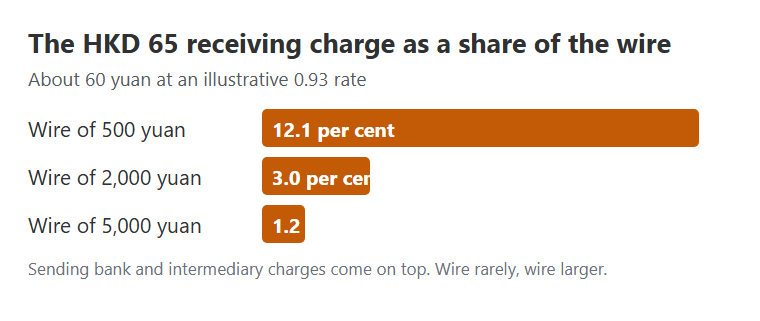
Plate: wires credited within two or three working days
A wire is slow twice: once between banks, once again inside the agent. The archive states both.
2–3
working days to credit
Bank wire
Archive wording
After the platform receives the remittance, it will be converted into RMB for you within 2 to 3 working days according to the exchange rate of the platform website at the time of receipt of the remittance. The recharge result will be informed through the website letter
What it comes to
Two clocks run here. The money must first arrive (banks "usually settle a money order within 2 – 3 working days"), then it is converted and credited within another two to three working days. The rate used is the one on the website on the day of receipt, not the day you sent it.
Check before you pay
- Allow up to six working days end to end, more across a weekend or a Chinese public holiday.
- Screenshot the website rate on the day the money lands.
- Watch the on-site messages; the archive says the result is reported by "website letter", not by email.
Plate: choosing the remittance currency
The exchange rate is where a zero-commission agent can still earn, and it is the figure the archive is quietest about.
FX
rate on the day received
Exchange rate
Archive wording
To avoid exchange loss, please choose the appropriate currency when you transfer money.
What it comes to
This is the only line in the archive about currency choice, and it carries no rate or markup. A second string says the currency you remit is converted to yuan "based on the exchange rate stated on Platform's website before we top up the amount for you". The exchange rate, then, belonged to the site, and the archive does not say how far it sat from the market rate.
Check before you pay
- On the day you pay, set the site rate beside a public mid-market quote and note the gap as a percentage.
- Send in the currency your own bank converts most cheaply; a double conversion is the "exchange loss" the line warns about.
- Repeat the comparison on the day of payment, since the site rate moves.
- Fee plates commission, formula, coupons and the freight bill
- Calculators count payments and deadlines
- Reader questions balances, refunds and withdrawals