
Trail through the Readout: Home Figure board Parcel plates
Pandagoo parcel figures, from quote to dispatch
Ten plates on how a Pandagoo parcel was priced, paid for and sent, including the size rule whose key number the archive never kept.
Parcels are where most of a Pandagoo order's money went and where the archive is richest in figures: quote windows, payment deadlines, a cancellation charge, a declared value range and the size rule. Ten plates follow the parcel from submission to the border.
Plate: system quote or manual quote
The parcel screen offered two ways to set the freight price. They read alike and behave very differently when the estimate is wrong.
2
ways to price a parcel
Quoting
Archive wording
System quotation: pay the freight first, after the warehouse completes the packaging, the freight more refund less compensation. The package is expected to take 1-2 days to send.
What it comes to
The system quote charged freight up front from an estimate and settled the difference after packing: overpay and the balance gets a refund, underpay and you top up. The manual quote reversed the order: "Submit the package first, and then pay after the warehouse completes the packaging. The package is expected to take 24 hours to send." One trades certainty for speed, the other speed for certainty.
Check before you pay
- Choose manual quoting for bulky or oddly shaped parcels, where estimates are most likely to be wrong.
- With system quoting, watch for a "Pending to pay difference" status; the parcel will not leave until it is cleared.
- Keep the estimate screenshot so you can check the final refund or top-up.
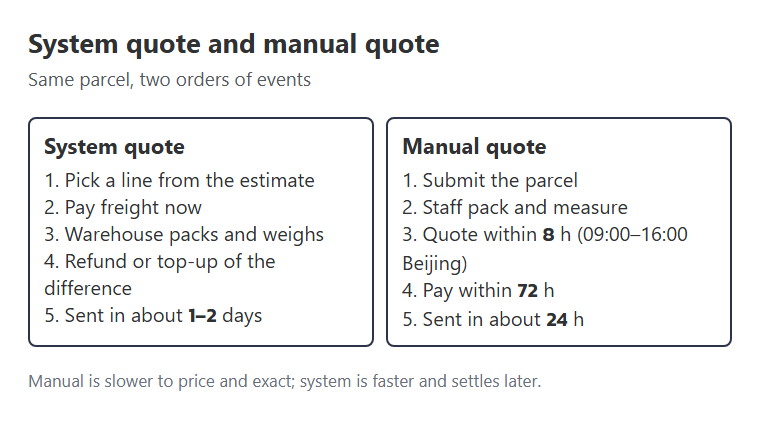
Plate: the eight-hour quote window
The manual route came with a time promise, conditional on when you pressed submit.
8 h
manual quote window
Quoting
Archive wording
6. If you submit your package between 9am and 4pm Beijing time, the warehouse staff will measure the volume and weight of your package and we will provide a freight quote within 8 hours.
What it comes to
The eight-hour promise only held for parcels submitted between 09:00 and 16:00 Beijing time. A parcel submitted at 17:00 waited for the next working morning before its eight hours began. Measurements were taken by staff, so the quote reflects the real box, not the sum of item weights.
Check before you pay
- Submit inside the 09:00 to 16:00 Beijing window if speed matters.
- Compare the measured weight with the item weights shown at arrival; a big jump usually means a large carton.
- Ask for a smaller box or removal of retail packaging before you pay, not after.
Plate: seventy-two hours between parcel submission and payment
The parcel deadline is the shortest clock in the archive measured in hours, and the one that collides with slow payment rails.
72 h
to pay freight
Deadline
Archive wording
After your international parcel is successfully submitted, payment must be completed within 72 hours. If it is overdue, the order will be automatically canceled. Please pay in time.
What it comes to
Three days from submission to payment, after which the parcel order is cancelled automatically. Cancellation here means the parcel request, not your goods; they return to storage. The catch is the cost of undoing work already done, which the next plate covers.
Check before you pay
- Have funds ready before you submit, especially if paying by wire or e-cheque.
- Do not submit a parcel just to see a price; use the estimate first.
- Set an alarm for 72 hours after submission in Beijing time.
Plate: twenty yuan to reopen a packed box
Changing your mind after packing carried a fixed charge, stated twice in slightly different words.
¥20
to reopen a packed parcel
Cancelling
Archive wording
4. If the warehouse has already packed the package, canceling the package will require the staff to unpack and re-enter the package, so we will charge a manual operation fee of 20 yuan.
What it comes to
Cancelling after packing cost 20 yuan, and the packing materials were not refunded ("canceling the package will not result in a refund of the one-time consumables used for packaging"). A second line charged the same 20 yuan, called a pickup fee, if you cancelled after paying for freight. Twenty yuan is small; the lost days are the bigger cost.
Check before you pay
- Decide on the parcel contents before submitting, not after the quote arrives.
- If one item is in doubt, leave it out; it can travel in the next parcel.
- Ask whether the consumables charge appears as a separate line.
Plate: the rehearsal package charge
The rehearsal package is Pandagoo's name for a paid trial pack. The service is described in detail; its price is a gap.
{amount}
yuan per rehearsal pack
Trial pack
Archive wording
1. Submit a rehearsal package: {amount} yuan per time.
What it comes to
A rehearsal package was a paid trial packing: staff pack, weigh and measure the parcel so you see the real numbers before choosing a line. The price per rehearsal was left blank in the archive. Refunds were possible only before processing began, and the text asks you to "try to avoid repeated submissions" because each one uses labour and materials.
Check before you pay
- Ask the rehearsal price before using it; if it is close to the gap between two line quotes, skip it.
- Use it for parcels near a weight band or with awkward shapes.
- Read the weight and size from the rehearsal details page and pay freight from there.
Plate: a declared value capped at one hundred twenty dollars
The customs value box had hard limits, which tells you something about the lines the warehouse expected to use.
1–120
US dollars declared
Customs form
Archive wording
Please fill in the declaration value, range: 1-120
What it comes to
The declared value box accepted any figure from one to one hundred twenty, labelled "Declared value ($)". The range is a form limit, not advice. Customs at the destination judge the declaration against the goods and the invoice trail, and the archive puts tax risk on the buyer in a separate line.
Check before you pay
- Declare what you paid. A value that does not match the goods is your risk, not the agent's.
- If what you paid is above the form limit, ask support how the parcel should be declared before submitting.
- Keep order receipts in case customs ask for proof of value.
Plate: volumetric weight without its coefficient
The size rule is written out in full except for the one number that decides the result.
L×W×H
÷ coefficient × 1000
Weight rule
Archive wording
The calculation method for the package is to take the volume weight (g) as the length * width * height of the package/volume coefficient ({rate}) *1000. The charge will be based on the higher of the actual weight and the volumetric weight
What it comes to
Bulky parcels are charged by size. Multiply the carton's three sides, divide by the line's coefficient, multiply by 1,000 to get grams, and you are charged on the bigger of the two numbers, the size-based one or the weighed one. The coefficient varied by line and was left blank in the saved text. A 40 by 30 by 20 cm carton on a line with a 6,000 coefficient bills as 4,000 g even if it weighs 1,800 g.
Check before you pay
- Ask the coefficient for each line you consider; a 5,000 line bills the same carton at 4,800 g.
- Ask for retail boxes to be removed where they add size without protection.
- Pack soft goods together so the carton is filled by weight, not air.
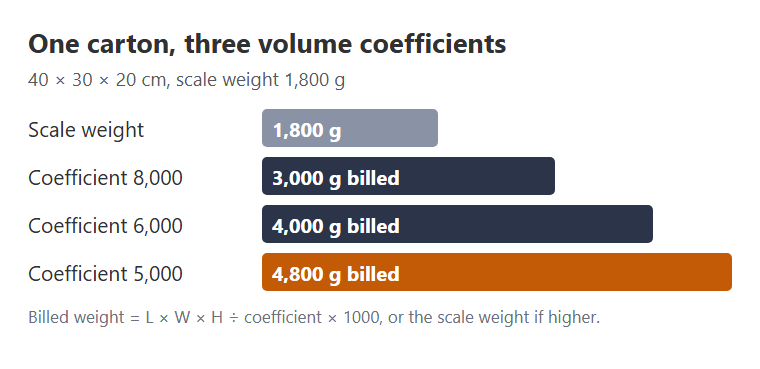
Plate: oversize bands measured in centimetres
Long items had their own drop-down in the freight estimate, sorted into length bands.
60–150
cm length bands
Long items
Archive wording
Greater than 120cm and less than 150cm
What it comes to
The freight estimate form sorted long items into four bands: over 60 and under 90 cm, 90 to 100, 100 to 120, and 120 to 150 cm. Action figures with non-metallic knives or guns had their own bands ("within 60cm" and "60-150cm"). Banding usually means a surcharge or a narrower choice of lines once an item passes 60 cm.
Check before you pay
- Measure the longest side of the packed item, not the product itself; packaging adds length.
- Fishing rods, umbrellas, standing lamps and large flags are the usual surprises.
- Ask which lines accept the band before buying.
Plate: a banned list that opens with perfume
The prohibited-items reminder is short and its order is telling.
10
goods on the banned reminder
Banned list
Archive wording
Please check if your order includes the following prohibited items: perfume, simulation guns, banknotes, antiques, weapons, knives, gunpowder, drugs, lighters, high-risk chemicals.
What it comes to
The reminder starts with perfume, ahead of weapons and drugs. Elsewhere the freight form drew a line at 10 ml: "Creams, cosmetic powders, and liquids below 10ml" had one category and larger liquids another. Items found in the opening check had to go back to the seller ("please return them to the seller"), at the buyer's cost under the general return rules.
Check before you pay
- Treat bottled fragrance as unshippable unless support confirms a line in writing.
- Check gadgets for built-in batteries; the form listed "Built-in battery" and "Power bank" separately.
- Read listing photos for lighters or blades packed as free gifts.
Plate: tax notices at the destination border
The last plate on parcels concerns what happens after the warehouse has finished with them.
random
customs checks at destination
Import tax
Archive wording
1. When the package is cleared at the customs of the destination country, if it is randomly inspected, there may be a risk of being taxed. If you receive a tax notice, please actively assist in customs clearance, otherwise a high return fee may be incurred.
What it comes to
Import tax is presented as a matter of chance inspection, paid by the recipient, with a sharp penalty for ignoring it: a refused parcel can come back with "a high return fee". The archive offers no tax-paid line or rate table, and none should be assumed.
Check before you pay
- Look up your own country's import threshold and charges before choosing a parcel value.
- Answer any tax letter promptly; an unanswered one costs more than the tax.
- Split very large hauls only if your country's rules make that sensible, and never to mislead customs.
- Deadline stack calculator turn the 72 hours into a date
- Return plates what happens once the parcel lands
- Blank figures the coefficient, rehearsal price and line prices