
Trail through the Readout: Home Figure board Fee plates
Pandagoo fee figures from the March archive, plate by plate
Zero commission on purchases, a gross-up formula on every payment, and a coupon total that looks larger than it spends. Five fee plates and the cost stack they add up to.
These plates cover the money Pandagoo itself charged or gave back. Prices of goods and freight belong to sellers and carriers; what sits here is the agent's own layer. Each plate quotes the archive copy of 8 March 2026 word for word, then says what the words come to and what to confirm before paying.
Plate: a zero purchasing service fee
Most agents in 2026 publish a buying commission, often a percentage of the goods. The archived Pandagoo screens advertised none, and said so in three places: a feature tile, a badge, and a longer promise in the "Platform solemnly promises you" block.
0
purchasing service fee
Commission
Archive wording
Platform promises not to charge any purchasing service fee for any platform or any product in China
What it comes to
The buying step itself carried no cut. When Pandagoo placed an order with a Taobao, Weidian or 1688 seller, the archive says nothing was added on top of the goods for that work, and a badge elsewhere on the same screen adds "(free forever)". The word "Platform" stands where the brand name was dropped in at runtime; the bundle we read is a white-label template, so read it as Pandagoo.
A zero here does not make the order free to run. It moves the cost to the places that still carry numbers: the payment handling formula on the next plate, the freight bill, and any gap between the rate you pay in and the yuan the warehouse spends.
Check before you pay
- Compare the checkout total against list price times quantity plus the seller postage. Any extra line is a fee by another name.
- Look for a separate rule for wholesale goods. The archive lists a page called "Rules for purchasing for 1688 products" whose text was never saved.
- Screenshot the checkout before paying, so a later dispute has the zero on record.
Plate: the payment handling formula
This line sat in the payment help text, under the heading for frequently asked questions about payment. It is the only place where the archive admits a cost on the money side, and it is written as a formula rather than a price list.
÷(1−p)
payment handling formula
Paying
Archive wording
Actual amount paid = (Amount payable for goods or parcels + US$ Fixed commission) / (1 - Percentage commission)
What it comes to
This is a gross-up, not a simple surcharge. First the fixed dollar part joins the amount owed; that total is then divided by one minus the percentage. Dividing by 0.96 costs more than multiplying by 1.04: with a 4 per cent setting the real take on a US$50 basket is about 4.17 per cent before the fixed part is counted. The formula names "goods or parcels", so it runs again when you pay freight.
The archive kept the shape of the sum and lost both inputs. The dollar figure and the percentage arrived from the server for each payment method, which is why no number appears in the quoted line.
Check before you pay
- Note the fixed and percentage figures shown beside each payment method; they can differ by method.
- Count your payments. Two goods checkouts and one freight payment means the fixed part is charged three times.
- Run your own numbers in the split-payment calculator before choosing how to pay.
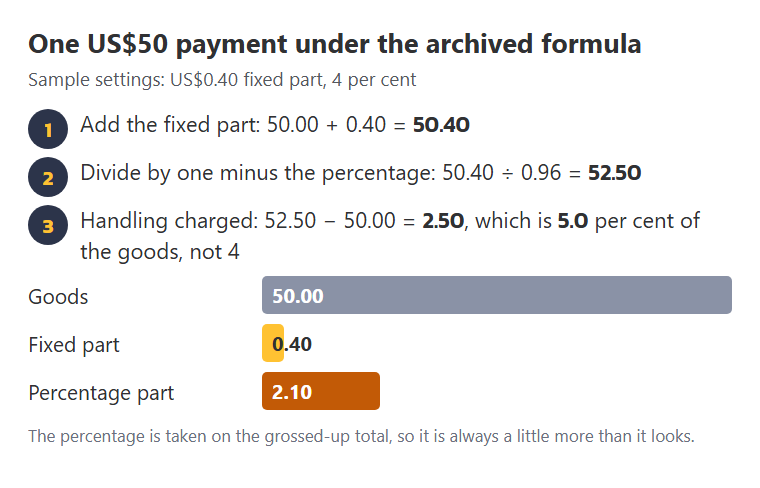
Plate: the shipping coupon bundle for a verified email
The biggest number anywhere in the archive is a coupon total, and it appears in a pop-up about email verification. It reads generous; the structure of vouchers on the next plate explains why it rarely is.
CNY 1080
shipping coupon package
Sign-up offer
Archive wording
Please verify your email address, or you may not place order successfully. Verify it now to get CNY 1080 Shipping Coupon Package!
What it comes to
Verifying the email address unlocked a bundle described as worth 1,080 yuan, aimed at shipping. The word "package" matters: it reads as a set of separate vouchers whose face values add up to that figure, not one 1,080-yuan credit. The same line also warns that an unverified account "may not place order successfully", so the email step was effectively required.
Check before you pay
- Open the coupon list and read each voucher on its own: spend threshold, expiry date, and which bill it can be used against.
- Expect most of the total to sit in vouchers that need a large freight bill before they apply.
- Treat the 1,080 as a ceiling you will rarely reach on one small parcel.
Plate: coupons with spend thresholds left blank
Voucher rules were stored as sentences with gaps. The gaps were filled from the server for each campaign, so the archive keeps the grammar of a discount and none of its size.
{amount}
coupon thresholds
Voucher maths
Archive wording
Get {amount2} off on purchases over {amount1}
What it comes to
The voucher text came in two patterns: a fixed amount off once a spend threshold is passed, and "{amount1}% off on purchases over {amount2}". A third string, "From {date1} to {date2}", gave each one a validity window. All of the numbers were filled in by the server, so the archive tells us the rules had thresholds and dates but not what they were.
Check before you pay
- Check whether the threshold is measured before or after the payment handling formula is applied.
- Look at the "Expired coupons" tab before planning a parcel around a voucher.
- Ask support whether a voucher can be combined with others on one parcel.
Plate: a freight bill with insurance and add-ons
The parcel payment page added several lines before the payment formula ran. Knowing the order of operations tells you where a voucher helps most and where insurance quietly grows the total.
4 lines
in a freight bill
Freight maths
Archive wording
Shipping cost amount - Voucher amount + Value-added service amount + Insurance amount
What it comes to
The parcel payment screen built its total from four lines: the line price, minus any voucher, plus value-added services, plus insurance. Only after that does the payment handling formula apply. Insurance and add-ons were separate entries with their own labels ("Insurance premium", "Insured amount"), so they could be switched on or left off.
Check before you pay
- Read the value-added list line by line and untick anything you did not ask for.
- Set the insured amount yourself rather than accepting a default.
- Remember the voucher is subtracted before handling is added, so its saving is slightly larger than its face value.
Fee structure drawn as one stack
Put the plates together and a Pandagoo order had four places where money could leave your hands: the goods and seller postage at list price, the payment handling formula on that payment, the freight bill with its add-ons and insurance, and the handling formula again on the freight payment. The buying commission, the tile everyone remembers, is the one layer that was zero.
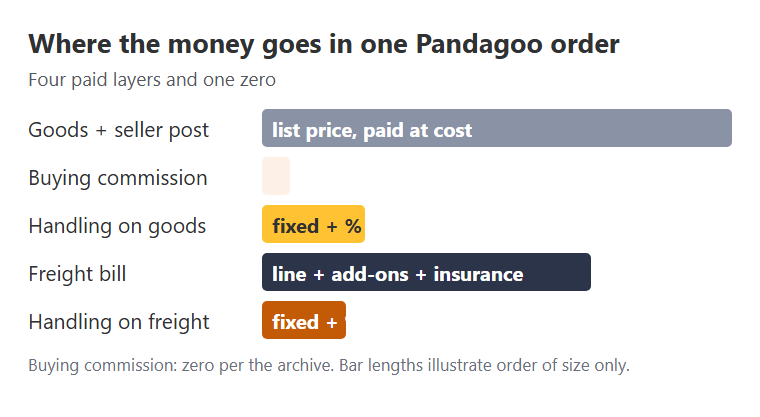
Two layers are invisible until checkout: handling, because its inputs were never saved, and the gap between the site's exchange rate and the market rate, covered on the paying-in page. The fee structure is not hidden, but it is spread across screens, which is why we drew it as one stack.
- Paying-in plates methods, top-ups, wires and the exchange rate
- Split-payment calculator see the formula with your own numbers
- Blank figures the commission inputs the archive lost