
Trail through the Readout: Home Calculators
Two Pandagoo calculators built on archived rules
A split-payment calculator that applies the archived handling formula to each payment you make, and a deadline stack that turns the archive's clocks into calendar dates.
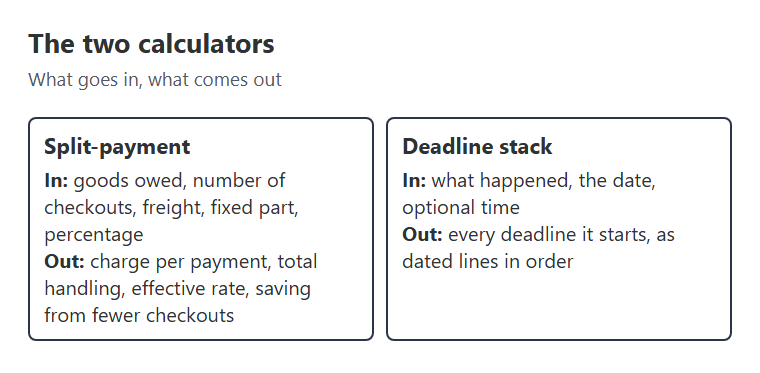
Split-payment calculator
The archived formula runs once per payment: (amount payable + fixed US$ part) / (1 − percentage). Most buyers pay more than once per haul, so the fixed part repeats. This calculator splits your goods across the number of checkouts you expect, adds the freight payment, and shows what each payment is charged and how much of the total is handling.
Deadline stack calculator
The archive is full of clocks: 72 hours to pay freight, 5 days to ask for a return, 3 days to report a fault, 12 days to refund, 15 and 60 days for forwarding, 300 days of storage. Pick what happened and when, and the calculator lists every deadline that event starts, in date order.
Getting sensible answers from both calculators
How to use the calculators so their answers stay honest about what is known:
- Replace the sample handling settings. 0.40 dollars and 4.2 per cent are stand-in values of our own choosing, labelled as samples. Real values came from the payment page per method; enter those if you have them.
- Convert yuan at the rate you will actually pay, not a headline rate. The site converted at its own rate.
- Count checkouts honestly. If you add items over several days and pay each time, each one is a checkout.
- Treat the dates as outer limits. The archive counted in Beijing time; the deadline stack counts in your device time zone and reminds you to keep a day in hand.
- Do not use either tool for a site that is down as anything but planning. No figure here is a quote.
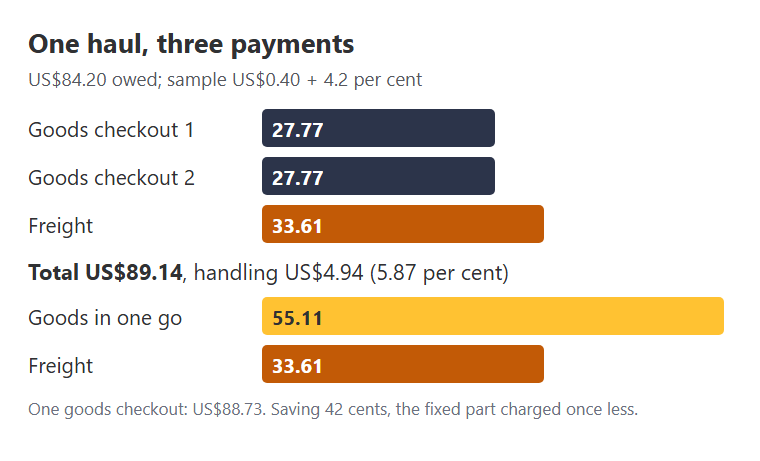
Worked example: one haul, three payments
Take the default inputs: US$52.40 of goods paid in two checkouts, then US$31.80 of freight, with a sample US$0.40 fixed part and 4.2 per cent. Each goods checkout of US$26.20 is charged (26.20 + 0.40) / 0.958 = US$27.77. The freight is charged (31.80 + 0.40) / 0.958 = US$33.61. The total is US$89.14 against US$84.20 owed: US$4.94 of handling, or 5.87 per cent, well above the 4.2 per cent setting.
Paying the goods in one checkout instead would charge (52.40 + 0.40) / 0.958 = US$55.11, and the haul would come to US$88.73. The saving is 42 cents. Small, but it is the fixed part being charged once instead of twice, and it grows with every extra payment.
- Fee plates the formula in its archive context
- Return plates every clock in the deadline stack
- Seven-leg guide where each payment happens