
Trail through the Readout: Home Reading listings
Reading wholesale listings by their numbers before you pick
How to choose a product and judge a seller on 1688 from the figures on the listing: price ladders, minimum batches, fabric weight, size menus in jin, and the fields sellers fill carelessly. Every example is a listing we read on 24 October 2026.
Pandagoo's archive names 1688 as one of its four source sites and even lists a page of "Rules for purchasing for 1688 products" whose text was lost. 1688 is Alibaba's wholesale market, and its listings are built for shop owners buying in bulk. They are full of numbers, and most of them are not the numbers a single buyer pays. The six sections below are what we look at before putting a card on our shelves.
Compare the quantity you need, not the lowest unit price
Illustrative shortlist: you need one hoodie. The figures below are invented, in CNY, before agent charges and international freight. A lower unit price can require a larger first payment.
| Listing option | Minimum goods cost | Decision |
|---|---|---|
| A: CNY 33, minimum 1 | 1 × 33 = CNY 33 | Matches a one-piece plan. Check the selected size. |
| B: CNY 30, minimum 3 | 3 × 30 = CNY 90 | Only compare if you actually need three. |
| Either option | Domestic delivery still unpriced | Ask for the delivery charge before using the calculator. |
Save the listing ID and selected option beside the calculation. Then use the payment calculator and the warehouse checks to keep ordering cost separate from what the arrival photos can establish.
Price ladders and the first tier
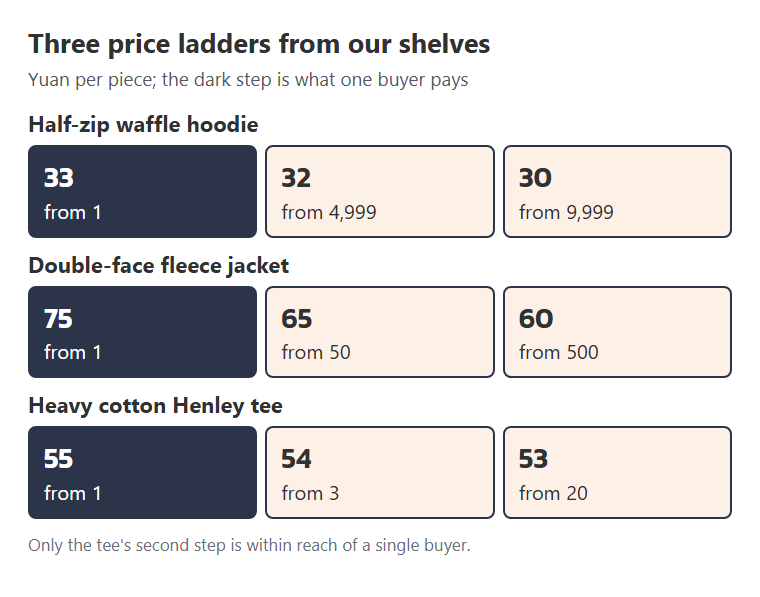
A 1688 price is a ladder: one price from a starting quantity, lower prices from larger ones. Only the first step applies to a single buyer. Examples from our shelves:
- A half-zip waffle hoodie: 33 yuan from 1, 32 from 4,999, 30 from 9,999. The headline "from 30" is a price for a warehouse.
- A double-face fleece jacket: 75 from 1, 65 from 50, 60 from 500.
- A heavy Henley tee: 55 from 1, 54 from 3, 53 from 20. Here the second step is within reach, so buying three saves three yuan.
Agent search pages often show the lowest figure in the ladder. Open the listing and read the step that matches your quantity; that is the number to put into the payment calculator.
Minimum batch counts on wholesale pages
The first step of the ladder often starts above one. Our shelves include canvas half-slip sneakers sold from two pairs, cotton joggers from two pairs, a wool knit vest from two pieces and a football kit from two sets. Each card says so in its middle number. A one-piece order on those listings either fails or is quietly bumped to the minimum.
Some minimums are written in the title rather than the ladder. An old-style cloth slip-on we looked at was quoted as "整件报价", a whole-case price, with a minimum of six pairs; a nylon waist bag was 3.50 yuan but only from ten. We leave anything above three pieces off the shelves, because splitting a case with friends is a different kind of shopping.
The archived Pandagoo screens show it checked this too: "The starting batch quantity is" and "The quantity of goods purchased cannot be less than" are both form messages.
Fabric weight is not parcel weight
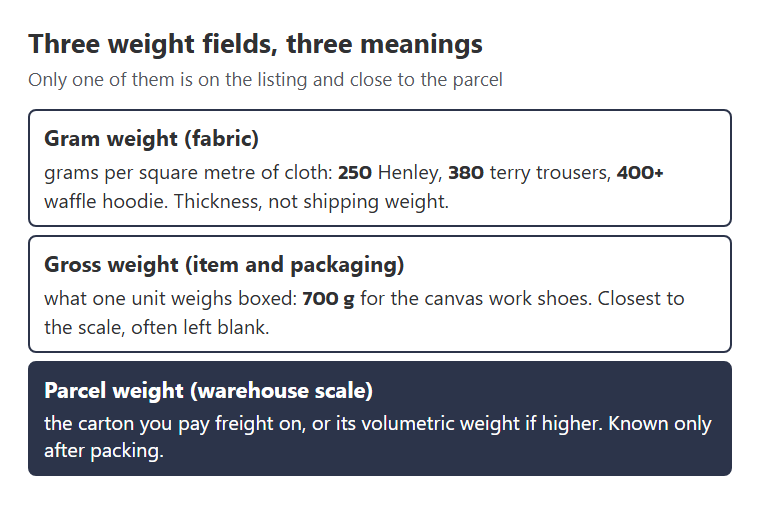
Clothing listings carry a "Gram weight" field: 250 g for a long-staple cotton Henley, 380 g for heavy terry sweatpants, "400g and above" for a waffle hoodie. That is fabric weight per square metre, a guide to thickness and warmth. It says nothing about what the warehouse scale will read.
The number that does is "Gross weight", which only some listings fill in. Our camouflage canvas work shoes give 700 g per pair with packaging. Another shoe listing we read gave "Other" in the same field, which is no help at all. When the field is empty, the warehouse arrival photos are the first reliable weight you will see, and the parcel quote the second.
Size charts written in jin and flat widths
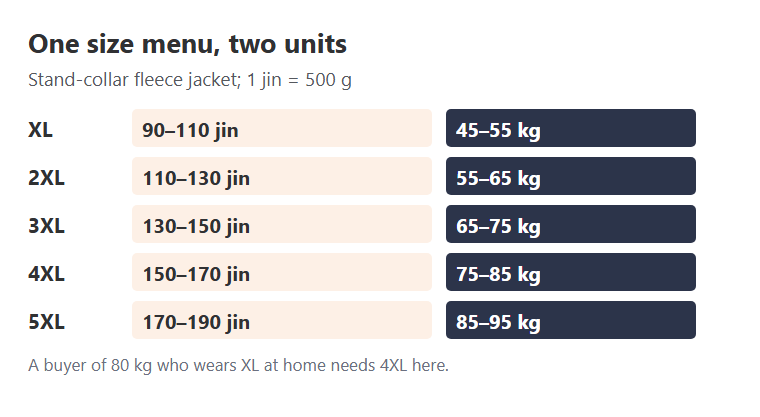
Chinese size menus usually tie each size to a body weight in jin, a unit of 500 g. The stand-collar fleece on our shelves sells XL for 90 to 110 jin and 4XL for 150 to 170 jin. In kilograms that is 45 to 55 kg for XL and 75 to 85 kg for 4XL. An agent's English page may already show the kilograms: the same listing read in English gave "Xl【 45-55kg 】", so check which unit you are looking at before halving anything.
Two more habits of these charts. Chest and waist figures are often measured flat across the garment, so a "chest 58" means about 116 cm around. And sellers state a tolerance: one kit listing says "Error range 1-3cm", another "+-2CM". Read those as the margin your QC measurement is allowed to miss by.
Seller figures worth a glance
Choosing a seller on 1688 comes down to a few fields that sellers fill in themselves, so read them as claims rather than facts:
- Sold in the last month. Our work shoes showed 1,305; a pair of canvas sneakers showed 2. A sales count is context, not proof of current stock; confirm the option you need.
- Source category. "Spot" means in stock. "Ordering" means made to order: one football kit listing says so and adds "Fastest shipping time: 8-15 days" before it even reaches the warehouse.
- Main downstream platform and export flags. Export flags do not establish fit or photo accuracy; use the measurements for the selected option.
- Inspection report number. Treat "1" or "00000" as empty, which is what we found on two listings.
A good seller shows real stock, sensible sizes, a clear ladder and option names that match the photos. One of those missing is normal; three missing is a reason to pick another listing.
Slips we caught in our own shortlist
Mistakes to watch out for, all from listings we considered for the shelves:
- A pair of raw denim jeans with the fabric name "chenille".
- A polyester fleece jacket whose main fabric is given as "Spandex", 70 per cent.
- A football kit marked for children whose size menu runs from 3XS to 5XL.
- A knit vest whose fabric fields all read "null".
- A canvas shoe photographed in front of a fashion magazine whose cover name is plainly legible, and a waist bag described as the "same style" as a sportswear label. We left both off the shelves.
None of these is a reason to distrust a whole listing. They are reasons to trust photos and measurements over typed fields, and to ask the seller one question before paying when a field matters to you.
- Product shelves the cards these examples come from
- Warehouse plates checking the photos against these numbers
- Calculators first-step prices into the payment formula